[ubermenu config_id="main" menu="969"]
Days
Hours
Minutes
Seconds

Nathan Beste

The construction of a metal nameplate can vary depending on the application. A metal nameplate can be built to withstand both indoor and outdoor use, vary in thickness, and have different metal characteristics. Information on metal nameplates can also be printed using different processes. It is important to understand these factors when choosing a metal nameplate that is right for your application. The most popular metal nameplates are: aluminum, stainless steel, zinc, and brass. Each metal has characteristics that make it right for some applications, and less suitable for others. To help you understand which material is most appropriate for your application, we’ve listed key features and benefits of each material.

The Metals

Aluminum

  • Very good chemical and solvent resistance
  • Good water, abrasion, and oxidation resistance when lacquered or anodized
  • Most versatile nameplate for decorative applications

Stainless Steel
  • Excellent water, chemical, abrasion, and corrosion resistance
  • Ideal for harsh indoor or outdoor applications
  • Retains sheen

Zinc

  • High heat resistance
  • Zinc nameplates can be tinted and deep etched
  • Allows for high-end graphics with intricate detail

Brass

  • Resist tarnish from water
  • Very good chemical and abrasion resistance and good oxidation and corrosion resistance
  • Available in a glossy or matte finish when a decorative metal nameplate is desired

Print and Decorative Processes

In addition to choosing a material, there are several metal nameplate printing and processing options. Each process is slightly different, and the printing and manufacturing may change based on the application needs.

Screen Printing

In the screen printing process, a squeegee is used to force ink through a selectively masked fabric screen that is used as a stencil. Screen printing on metal nameplates provides vivid color and offers good ink durability.

Offset Lithographic and Flexographic Printing

Offset lithographic printing is a process where ink on a metal roller is applied to a cylindrical rubber stamp then transferred to a sheet of metal nameplates. It uses a four-color printing process that creates sharp images. Flexographic printing is similar to offset lithographic printing, however it allows the image to be transferred directly from a rubber roller to the nameplate. Flexographic printing has higher setup costs, but is more cost effective for large production runs.

Embossing

Embossing a metal nameplate raises the text or logo above the original (normal) surface creating a three dimensional look.

Laser Marking

Laser marking uses amplified light to remove material from the surface of a metal nameplate. It is frequently used for barcoding and serialization.

Chemical Etching

Chemical etching is a process where chemicals are used to remove material from a metal sheet to create a message or logo. The etched area can be filled with color to provide a more visually appealing nameplate. The process of adding color to an etched nameplate is known as etch and fill. Chemically etched nameplates will remain legible even if the surface is painted over or left untreated. Etched metal nameplates are also resistant to abrasion.

Photosensitive Processing

The photosensitive process is used to produce anodized aluminum nameplates. It creates a hard anodized layer that is infused with a silver compound which, when exposed to light, creates an activated latent image. This makes the nameplate more durable and corrosion resistant. Known for their extreme printing accuracy and quick turnaround times, anodized photosensitive processed nameplates are commonly used in military and automotive applications.

Stamping

Stamping is the opposite of embossing. It is used to depress copy below the surface of the metal nameplate. Stamping is often used for applying variable information onto nameplates.

Learn More

Use this post as a guide to choosing metal nameplates, and to understand the types of customization options available using various printing techniques.

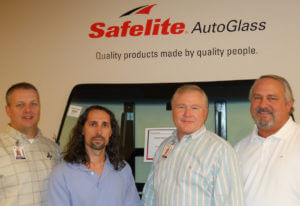
When Safelite Glass Corporation – the nation’s largest exclusively domestic producer of windshields for the vehicle glass replacement market – needed a special barcode sign to improve its order fulfillment process, it came to William Frick & Company – a leading producer of custom identification products like tags, signs and utility markers.

“We produced an extended barcode that wrapped around the barrel of a 10-inch diameter tube that Safelite hung from the ceiling of its distribution center,” said Brent Howell, business manager of William Frick & Company. “Most of Safelite’s order fulfillment is completed on forklifts, and their drivers were having trouble aligning the readers to the signs, which were flat. The curved surface of the tube gave their forklift drivers many angles from which to read the sign and sped up the picking process significantly.”

The new distribution center signs were part of a larger initiative at Safelite to increase sales through improved product availability. To meet this objective, Safelite needed to get a supply chain infrastructure that could support twice the volume it had been shipping. “Growing sales to leverage that infrastructure commitment became our #1 challenge,” explained project leader Michael T. Bradsher, Safelite director of accounting, manufacturing and distribution controller. “With all the infrastructure that was going to be needed to support a doubling of the shipping volume, we purchased and installed a Warehouse Management System (WMS). We also installed Frick’s more efficient barcode signs. The results have been impressive, with two physical inventories at or above 99.99 percent accuracy and reduced back office staff.”

“Frick is proud to have contributed to Safelite’s productivity and efficiency gains,” added Howell. “We congratulate Bradsher and his team for winning … Supply & Demand Chain Executive “Pros to Know” Team Award.”

Bradsher’s team was comprised of the following people: Kemp Edwards, DC Manager; Bobby W. Sanders, Jr., IT Support; Andy Scott, DC Shift Manager; Robert Tyner, Inventory Control Specialist; John Moore, IT (Retired); Randy McCombs, IT.

About William Frick & Company A leading producer of customized identification products like RFID tags, barcode labels, utility markers and signs, William Frick & Company is a trusted supplier to the telecommunications industry, oil and gas companies, electric utilities, governments and others needing labeling solutions. Frick offers best-in-class identification products and services customized to client specifications. The company is ISO 9001 certified. For more information about William Frick & Company product offerings, procurement options, service and solutions, call (847) 918-3700.

About Safelite Glass Corp. The nation’s largest exclusively domestic producer of windshields for the vehicle glass replacement market, Safelite Glass Corp. has a manufacturing facility in Enfield, N.C. as well as two distribution centers located in Ontario, Calif. and Braselton, Ga. The manufacturing facility serves all of the Safelite Group retail units and the customers of Safelite Group’s wholesale operations, Service AutoGlass®. The Safelite Glass Corp. manufacturing and distribution facilities are ISO-9001 certified.

All About Domed Labels

Domed labels are thicker than standard labels because they feature a robust barrier against various elements while enhancing the visual appearance of your graphic. To help determine whether domed labels are the right choice for your business, request a free sample today.

Durable Construction

Polyurethane, which is a resin used to create the dome on top of the label, is one of the most inert types of plastics available and intended for years of use indoors or out. This resin provides scratch-resistance and is self-healing which shields your graphics from abrasive encounters. Domed labels are also resilient against harsh chemicals, extreme temperatures, and retain their clarity even when exposed to continuous UV rays. These features make domed labels ideal for your industrial or commercial applications.

Draws Attention

Domed labels, 3D appearance, attract more attention compared to flat labels. The transparent resin provides added visibility not just to display, but to emphasize important identifiers, instructions or emergency information. Moreover, because domed labels enhance the visuals of your graphics, they are the perfect finishing touch to branded products. Other common uses include product marking, promotional branding, decoration and more.

Versatile Customization

Like all William Frick & Company labels, domed labels are fully customizable. Choose to add text, and a logo or graphic, coupled with many base materials and printing options. Embossing and chrome or carbon fiber film can create a truly unique. In addition to these elements, the dome itself can be customized to meet the specific demands of your utilization. Lastly, domed labels are available with a pre-defined radius for attachment to curved surfaces.

Professional Appearance

Thanks to the glossy, glass-like appearance, domed labels invite individuals to look – and touch. Instead of merely adhering to a product, domed labels look as if they are part of the product. Their shiny, thick polyurethane dome catches the eye and delivers a high-quality appeal that flat alternatives may not be able to achieve.

Request a Quote

With more than 40 years of experience in labeling products, we’re ready to answer your questions and explain customization options to help guide you to the right purchase for your needs.

Blank Heavy Duty Label Rolls May Not Be as “Heavy Duty” as You Think

Have you ever purchased something based on the stated information, waited for it to arrive, and disappointed to find the product wasn’t what you were expecting? If so, you are not alone. When searching for a durable label online, the term “heavy duty” can lead you to believe you’re getting a product that will survive harsh conditions and repeated use when this is not the case. Here’s what you need to know before searching for “heavy duty” labels online.

Deciphering the Term “Heavy Duty”

When searching for labels, the term “heavy duty” has its uses. However, some of those labels are only built to last a short amount of time or aren’t as sticky as they need to be. When a company claims their labels as being “heavy duty,” it may apply to that subset of labels – but that doesn’t mean it will apply to your application. If you find you’re frequently replacing your labels despite the fact it’s advertised as “heavy duty,” there’s a good chance they aren’t right for your application.

Understanding the Four Parts of a Label

When it comes to finding or constructing a label that will suit your application, there are four essential components to consider:

Adhesives

There are many types of adhesives. Some are slightly tacky for clean removal, others are considered “permanent” depending on the application, and dozens of others fall between these two extremes.

Materials

The actual label material also plays a role in how well it holds up in certain environments. A label made from thin paper, for example, will deteriorate when exposed to rain while a label made from vinyl, polyester or similar materials will stand up to those conditions.

Ink

Inks used in off-the-shelf printers are often inexpensive and not as heavy duty as they should be. Many won’t resist UV rays, solvents, oil, abrasion, or even water. Instead, consider inks for commercial and industrial use.

Lamination

Finally, lamination is one of the most important factors when purchasing a truly heavy duty label. It shields both the material and ink from the elements and harmful chemicals. Laminates made with a high performance material such as heavy polyester will hold up in about any environment.

The durability of heavy duty labels is in the ink and lamination. If not constructed of high-grade inks and lamination, the label may not be heavy duty enough. When searching for a label that best suits your unique application, remember that each of these four label components can be modified to produce the right product for your needs.

Rather than buying average blank or pre-printed labels, it’s essential to turn to experts who understand your specific requirements for your unique application – that’s where William Frick and Company excels. No matter your application, we can work with you to find or construct the perfect solution by ensuring all four components of your label are correctly combined to provide lasting durability and superb adhesion to surfaces.

Extreme Manufacturing Meets Extreme RFID Tracking: Discover the High Temperature Armored 300C RFID Tag

RFID not only helps make workflows more efficient by saving time and minimizing error, but it also gives you more flexibility by reading multiple tags at once and the ability to reuse tags. However, you might think that because your manufacturing facility has extreme conditions, RFID technology is limiting since many options will not survive your environment. Thanks to technologies like the SmartMark™ High Temperature Armored 300C RFID tag, available from William Frick and Company, this is no longer the case.

What Is the SmartMark High Temperature Armored 300C RFID Tag?

Typical RFID tags will not survive industrial and commercial processes, like powder coating, where parts are exposed routinely to extreme temperatures and chemicals. Tags like the high temperature Armored 300C RFID tag, provide you the benefits of RFID technology no matter how intense your facility environment is. This unique tag withstands extreme temperatures and many passes through chemical processes while still maintaining its readability and function. It also resists motor oil, most solvents, and the majority of acids and bases without affecting the operation or readability of the tag. Most RFID tags cannot survive exposure to both high temperatures and extreme chemicals.

The high temperature Armored 300C RFID tag welds or bolts to metal surfaces, including claws and racks used that move parts around assembly lines. It offers incredible survivability even when it comes to numerous layers of chemicals and exposure to temperatures up to 300 or 400 degrees Celsius (572-752 degrees Fahrenheit) for brief periods of time.

Thanks to its housing, the high temperature Armored 300C RFID tag reads best on metal surfaces due to the metal amplifying its signal. Its read range has been tested to read up to 6.5 feet. You can attach the tags to virtually any ferrous or non-ferrous metal surfaces. RFID Tag & System Solution.

The high temperature Armored 300C RFID tag solution is excellent for industries that could benefit from RFID technology but have previously been unable to use it due to challenges extreme environments create. These industries include everything from automotive manufacturing to oil, gas and water, healthcare, and construction.

With manufacturing facilities now having the ability to track their extreme processes with the high temperature Armored 300C RFID tag, implementation of an RFID system may be another constraint to using RFID. Many enterprise RFID systems are known to be expensive and require large infrastructures. However, there is an affordable option available for manufacturing.

Affordable RFID Capture System

Our system is a flexible and scalable data collection platform that allows you to collect clean and verifiable data using custom digital forms and RFID. The mobile and cloud based deployment eliminates an extensive and costly infrastructure. Increase visibility into your business by creating relevant dashboards to review your collected data and make data-driven decisions.

If you’re interested in learning more about the ways our technology can benefit your company, contact the friendly experts at William Frick and Company today. With this unique tag’s incredibly rugged build and durability in various extreme environments, it could be the perfect solution for your tracking, identification, or quality control needs, no matter what kind of situation you expose it too.

Marker posts are ideal for identifying buried electric cable, fiber optic routes and gas and water pipelines. While there are several product manufacturers, not all of these products are the same. There are many things to consider when choosing the right post markers for your company or organization, but durability should be at the top of the list. Three unique types of marker posts are available from William Frick & Company – DomedPost®, TestPost®, and FlexPost® – offer outstanding quality and a solution to your need.

DomedPost Markers

DomedPost Markers are made of 100% virgin high-density UV-stabilized polyethylene for incredible durability. The 360-degree visibility ensures proper viewing from all sides and the graphics are just as durable as the posts themselves. Rather than stickers or surface printing, the graphics are embedded in the post to prevent fading, chipping, and peeling.

DomedPost markers come in standard lengths, APWA colors, and graphics, but all of this can be customized to your needs if you prefer. Each post comes with an anchor bar for installation, and they last up to 25 years or more.

TestPost Markers

TestPost Markers build on the quality and durability of DomedPost markers with the addition of a cathodic protection test station/terminal. These terminals are enclosed in high-impact Lexan, which is a polycarbonate plastic that can withstand even the harshest outdoor environment. To make wire attachment easier, optional compression lugs are available, and you can also choose an optional customizable faceplate that is rugged enough to stand up to the weather, repeated handling, and more.

Just like the DomedPost, TestPost markers are available with standard sizes, colors, and graphics, but these can be customized. The polyethylene post and the graphics offer up excellent resistance to precipitation, chemicals, UV rays, and abrasion. The posts themselves will last for 25 years or more, and the graphics are guaranteed to last a lifetime.

FlexPost Markers

FlexPost Markers are also durable, but their bendable nature lends well to certain environments where impacts with vehicles, equipment, or even livestock are common. They are made from quality flexible reinforced composite fiberglass so they spring right back into its original position following disturbances and impacts, which can greatly reduce the need to replace or repair post markers in the field. FlexPost markers resist water, solvents, fading, and abrasion, and they can be used in temperatures ranging from -40 degrees to 185 degrees Fahrenheit.

Each post can be customized with your choice of reflective or non-reflective vinyl labels that feature permanent adhesive and high-quality UV resistant lamination. FlexPost markers come in standard sizes and APWA colors, but these can be customized to your needs. You can also customize the graphics for each post with your own custom message or logo.

Marker posts are effective tools for marking things like underground utility lines, property boundaries, trails, and more, and choosing the right marker for the job is critical for its overall success. DomedPost, FlexPost, and TestPost markers from William Frick and Company can serve all of these purposes, and thanks to the company’s dedication to high-quality products, they will continue to do so for many years to come.